

By Rev. Racquel R. Ray, MDiv
Associate Minister of Congregational Life
As the new year breaks open but has yet to reveal her secrets, we wait with darkness for dawn to enlighten our days. We reflect on the past year and are surprised at our ‘year in review’ posts, photos, and calendars. We did so much! And yet, the new year is a blank canvas; open for new possibilities and new blessings.
As I reflect on last year, I’m still thinking about a strange encounter I had at the local bakery on my street. On one Sunday morning, I was wearing my clergy collar and typical church suit, and stopped in to buy several loaves of bread to share with visitors to the church. I was going to preach on the value of hospitality and the importance of radical welcome in our congregation. A neighbor approached me in the bakery, noticed my collar and asked, “What church are you from?”. I answered and their response was, “Oh! That’s MY church. I’m a member there.”
In my four years with the church, I have never met this person. I was delighted to meet a new (to me) member. And, I was wondering how this person considered themselves to be a member of the church but not a person who regularly attends. And, I wondered how many residents of the town consider the church where I serve to be “their church” whether or not they attend. 
Last semester, I took a class wherein ministers were asked to deeply research their ministry context. We were asked to take photos of the inside and outside, video recordings, audio recordings, research the history of the land, and research the history of the buildings. We were asked to describe the congregation’s demographics, passions and ministries, gifts and talents, and the mission of the church. We were asked to identify challenges in our ministry settings and think through solutions to those challenges. Over the course of the fourteen weeks, I thought often of the church and the membership and of the ‘stranger’ who I met in the bakery.
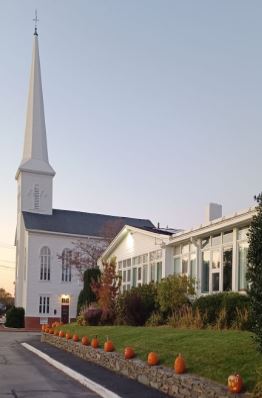
I believe that because the church is a historic, geographic, social, spiritual, civic, and even political landmark in the town, many residents consider the church “their church” or “the town church”. It is true that when describing the town to others who are familiar with the state, people often recall the big white historic church at the first crossroads in town. Many generations have come through our doors not only for worship but also for the role we play in the community: Boy Scouts, Girl Scouts, Gardening Club, protests, prayer vigils, and Interfaith gatherings. The welfare of our church matters – not only to the people who regularly attend Sunday worship but also to those in town who consider it “their church”.
 I’m reminded of the scripture from Jeremiah, “But seek the welfare of the city where I have sent you into exile, and pray to the Lord on its behalf, for in its welfare you will find your welfare.” This scripture is from Jeremiah 29 and contains the words of a letter that Jeremiah sent from Jerusalem to the exiles in Babylon. Many of us recall the instructions that precede this plea for the city, “Thus says the Lord of hosts, the God of Israel, to all the exiles whom I have sent into exile from Jerusalem to Babylon: Build houses and live in them; plant gardens and eat what they produce. Take wives and have sons and daughters; take wives for your sons, and give your daughters in marriage, that they may bear sons and daughters; multiply there, and do not decrease.”
Many of us have done just that. We settled in this town and raised our families with a sense of divine blessing and communal purpose. We built or bought houses, planted gardens, and watched as our children grew, married, and had their own children. The community is filled with others doing the same. And, we’ve prospered as a result. And, so has the church.
As we live into the new year, I pray that I get to meet everyone who sees the church where I serve as “their church”. I pray that the people who regularly attend on Sunday mornings invite their neighbors to their church. I pray that we value and appreciate the place that “our church” has in the community and we find innovative ways to support the church and insure its prosperity for many more generations to come. I pray for the welfare of the city and all of our neighbors. I pray that “our church” continues to be a landmark, a beacon, and an anchor for the community.